I will say that I was all about early academics when I first contemplated homeschooling. My husband was doing graduate work in gifted education, and that was a topic of interest for me as well. I observed and taught many gifted children and saw what they could do. (And I knew, of course, that my children would be gifted too.) Of course one must accelerate the academics so as not to hold back a talented student.
I hear more questions about what to teach to preschoolers than about anything else. (Maybe it’s because young mothers are the ones who read blogs about homeschooling!) Anyway, this has been on my mind of late, and I hope I can communicate what I’ve been feeling.

But I also saw that these gifted children were CHILDREN. They laughed at the same silly jokes that would make any child laugh. Some were incredibly disciplined, but they were still learning how to make good choices. All of them needed their parents nearby.
My priorities began to change as my own children came along. I moved from a world of “high grades and test scores are everything” and “you can go as far as you want, if you’re smart enough” to a world of just enjoying the sweet smell of a baby and wanting to keep my little ones close (usually). That high-pressure, competitive world—though I sometimes missed it—was no longer my main goal. I also wanted my children to feel secure, to have deep spiritual roots, to grow strong and healthy in every way. I saw homeschooling not only as a way to maintain high academic standards, but as a way to protect my children from bad influences which could jeopardize these other priorities.
What I finally realized is that LIFE is the curriculum for a young child (and hopefully that will continue to some extent as he grows older). Ideally, the preschool years should be spent around Mom and Dad, observing them and helping them as soon as the child is able. This is an education in how a family works and how a home is run. The family celebrates the seasons and holidays, and the child learns about his culture. The family visits friends and relatives, and the child learns how to get along with other people. I wonder how different our society would be today if children got more of this education?
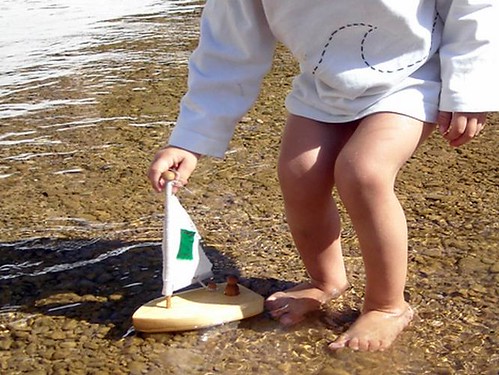
The child plays outside where big-muscle movements stimulate his brain and make his body strong. What his body and brain need most--especially in the preschool years--are good food, plenty of movement, and ample sleep (12-14 hours every day).
Daddy tells stories at bedtime. The child wants the same stories over and over—and that is also a part of his education. Daddy never speaks in baby-talk though, so the child learns rich use of his language. He knows the stories so well that he can fill in those wonderful-sounding words even when Daddy misses them.
Mommy sings songs while she makes the meals. She sings about what she’s doing or just sings songs that make everyone feel happy. Sometimes she makes up little rhymes when the child has a question. (You don’t have to be a poet! One of D’s favorites was a silly song that went “When the ground shakes, it’s called an earthquake. Doodly doodly doo.”)
Of course the child will ask lots of questions and will want to learn things, especially if he has older siblings that are doing them. If he wants to know how to write his name, he should be shown his name—but not asked to learn the alphabet. When he asks about numbers, they can be explained—but with concrete objects, not with symbols. This time of life is more about a child observing his world than about memorizing facts. If there are older children in his family, the child probably “does school” with them, but his work consists of modeling with clay, knitting with his fingers, or building towers with the math manipulatives.
Two of my children taught themselves to read in their preschool years, but one didn’t read until he was ten years old. That gave him a slower start, but didn’t seem to make a difference by age 12. Did you know that research (Bloom, University of Chicago) has shown that an entire K-12 curriculum can be taught to an older student in just nine months? THERE IS NO RUSH! There is plenty of time for the academics, but only a few short years of carefree, light-hearted, imagination-filled childhood. As my dear Marsha Johnson puts it, “You are not filling up a bucket. You are lighting a fire.”
The World will tell you otherwise. You will be pressured—by friends, perhaps by family, even by the government—to help your precious little ones “get ahead” (of what?). Please take some time to write down your priorities for your children—both long- and short-term. Ponder and pray about what is needed to help your children achieve those goals. Then don’t be swayed by others who don’t know your family as well as you do. Your educational choices may be different than mine, but I hope they will include much more than academics.


